

BEFORE YOU BEGIN
Give the work a clear starting point.
Connect and authenticate a supported agent first. Know which decision you need to make, who will maintain the result and what context you can share. You can begin with unknowns; make them explicit.
SAMPLE STARTING PROMPT / ADAPT TO YOUR PROJECT
Help me decide whether to add a customer portal to our existing website or build a separate app. Research only; do not implement anything. Compare the options for a small team. Consider the current website stack, customer sign-in, access to customer data, ongoing maintenance, deployment and cost. Ask for missing context rather than assuming it. Use current authoritative sources and link them. Separate facts from assumptions. Return a concise decision brief with tradeoffs, open questions, a recommendation conditional on what we know, and what could change it. Do not create accounts, buy services or change the website.
01CHOOSE THE FLOW
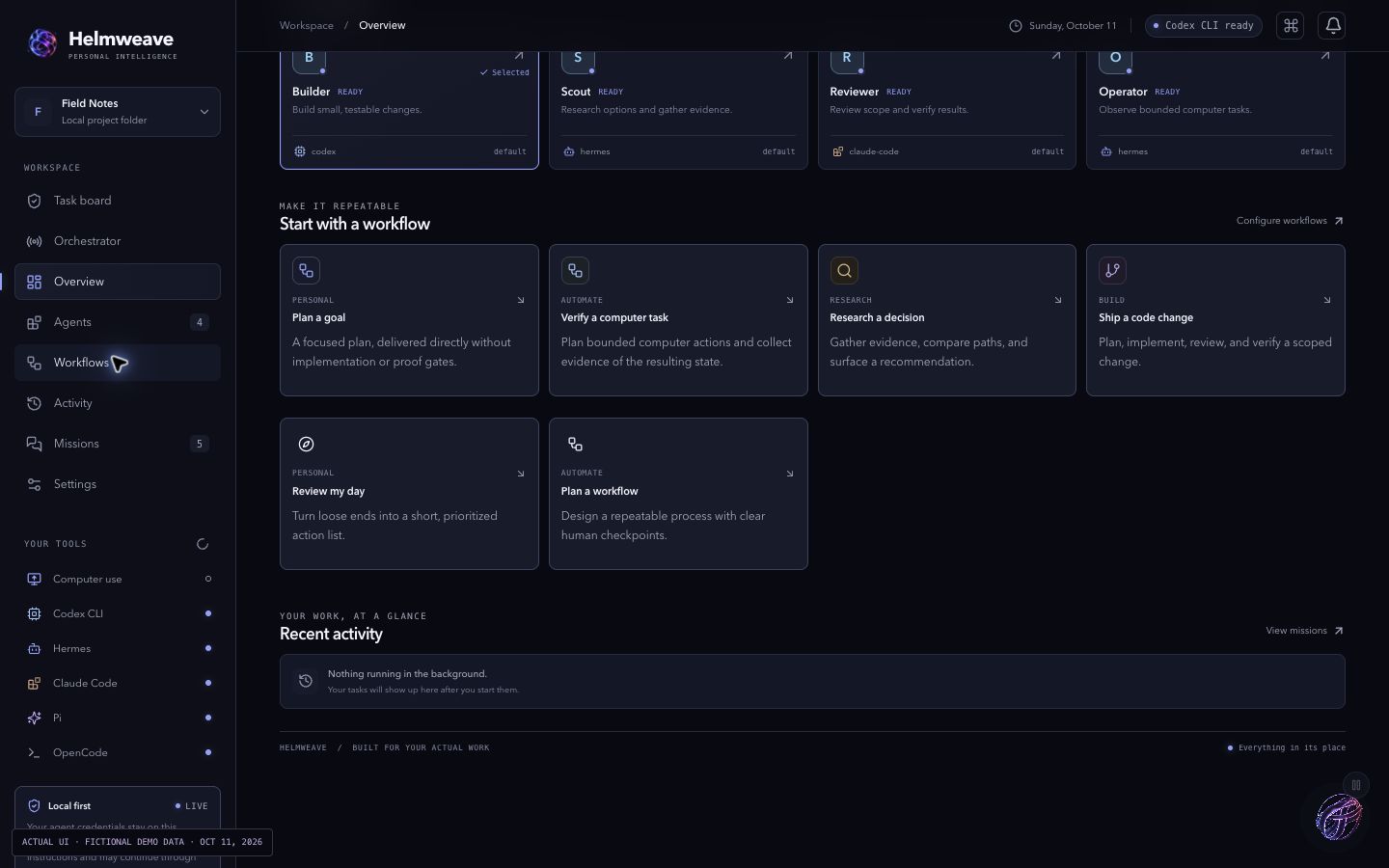
Choose Research a decision.
In Overview, choose Research a decision from the workflows and adapt the starter prompt. Check the selected agent and project context before sending. A template can have a preferred runtime and agent; your current selection can override it.
This flow asks for sources, viable options, tradeoffs, uncertainty and a recommendation. Planning and research return findings directly through Working → Complete. They do not add the task testing, verification or workflow approval gates used for implementation. Actual permission requests can still require action.
YOUR REVIEW CHECKPOINT
Confirm that you are requesting research only. Selecting a workflow does not install or authenticate its agent, and the template is not permission to change your project.
02FRAME THE QUESTION
Give the comparison real constraints.
For this example, the question is whether a customer portal should live inside an existing website or in its own app. Add the facts you actually know: the current stack, the people using the portal, the data they need and the team’s ability to maintain it.
If those details are missing, ask the agent to state assumptions and list the questions that would change the recommendation. A confident answer built on an invented website stack will not help you decide.
| Question | Existing website | Separate app |
|---|---|---|
| Sign-in & data | Can the current stack support the required customer access? | How would identity and data connect to the existing system? |
| Maintenance | Who owns changes across the site and portal? | Who owns a second codebase and its dependencies? |
| Release & cost | How would portal releases affect the existing site? | What extra hosting, operations and release work is needed? |
YOUR REVIEW CHECKPOINT
Agree on the decision criteria before weighing the options. Do not treat the questions in this table as evidence that either approach is better.
03INSPECT THE EVIDENCE
Follow the sources behind the answer.
Ask for current official documentation for the systems under consideration, with links next to the claims they support. Check that the sources apply to your version, deployment and intended use. Time-sensitive prices and product limits need a date.
Read the reasoning as well as the recommendation. Useful findings distinguish what a source establishes, what the agent infers and what remains unknown. If a source cannot be accessed, retain that gap rather than filling it with a plausible answer.
- Do the cited pages support the specific claims?
- Are both options compared against the same priorities?
- Does the recommendation change if a key assumption is wrong?
YOUR REVIEW CHECKPOINT
Open the decisive links yourself. A citation or a completed research status does not establish that the recommendation is correct.
04REVIEW THE DECISION
Keep uncertainty beside the recommendation.
Ask for a brief you can review with the people who own the website and customer experience. It should explain which option fits the known constraints, why, and what new information would reverse that advice.
SUGGESTED BRIEF STRUCTURE / NOT A GENERATED RESULT
- The decision and confirmed constraints
- Options compared against the same criteria
- Source links, dates and limitations
- A conditional recommendation and its reasoning
- Open questions and the next decision
You can ask for clarification or a revised comparison before acting. This is your judgment checkpoint; research has no implementation plan-approval gate.
YOUR REVIEW CHECKPOINT
If the evidence is incomplete, decide whether to gather more context, narrow the question or leave the choice open. Completion is not an obligation to start a build.
05CHOOSE THE NEXT STEP
Make implementation a separate decision.
Once you choose a direction, carry the reviewed findings and remaining constraints into a separate implementation request. Use a verified software workflow for code changes, with its own scope, plan, task checks and final review.
Specify the project and checkout, the acceptance criteria, and what needs your approval. A research recommendation does not authorize accounts, purchases, a deployment or changes to the existing site.
For a recorded example of that next kind of work, follow Build a landing page.
WHAT YOU TAKE AWAY
A decision brief to review
The intended deliverable is an inspectable decision brief: sources, tradeoffs, assumptions, uncertainty and a conditional recommendation. This tutorial does not claim an answer to the portal question; no research mission was executed.
Workflow behavior was checked against the local product source and the public workflows overview on October 18, 2026. The next useful action depends on the evidence you gather for your own project.
CONTINUE EXPLORING
Build a landing page
Go inside Daylight: a fictional product page built in a real mission. Follow the plan, connected tasks, execution blocker, scoped retry and final acceptance.
Read the next guide